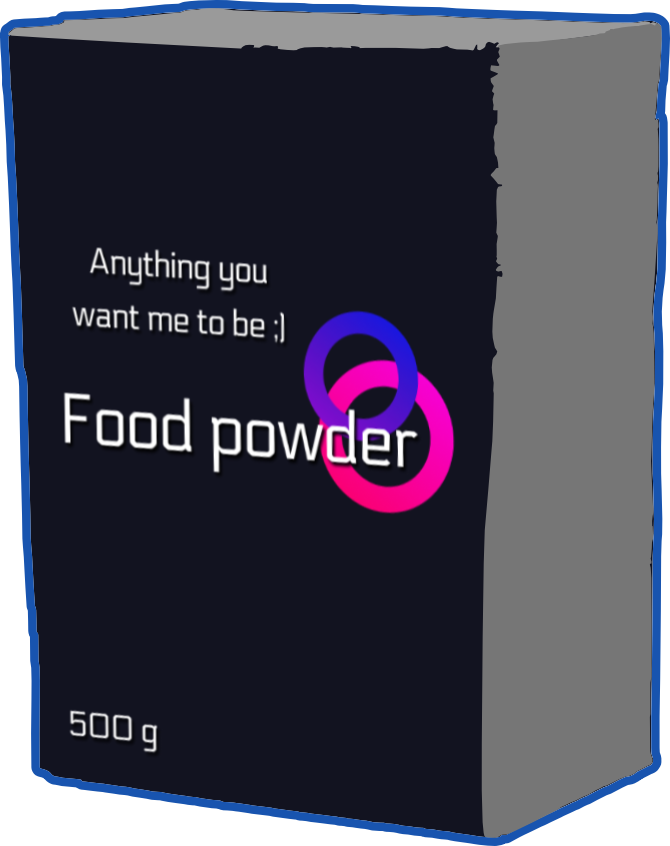
Our future scenario is that people will rely on food printers that use powder to make food. The printer can be set to produce exactly the characteristics you want. You might get a little crunch under your teeth, but that's no big deal. It's still edible and mostly just the way you want it. Right?
Packaging and printer UI design: Anna-Riika Jatsa
Camera operator and video editing: Kristin Silm
With our scenario, we wanted to raise the question: What if our comfort with visual based food decisions left us clueless about where our food really comes from?
We wanted people who saw our project to think more about their food choices and dare to investigate more closely where the ingredients in their food actually come from.
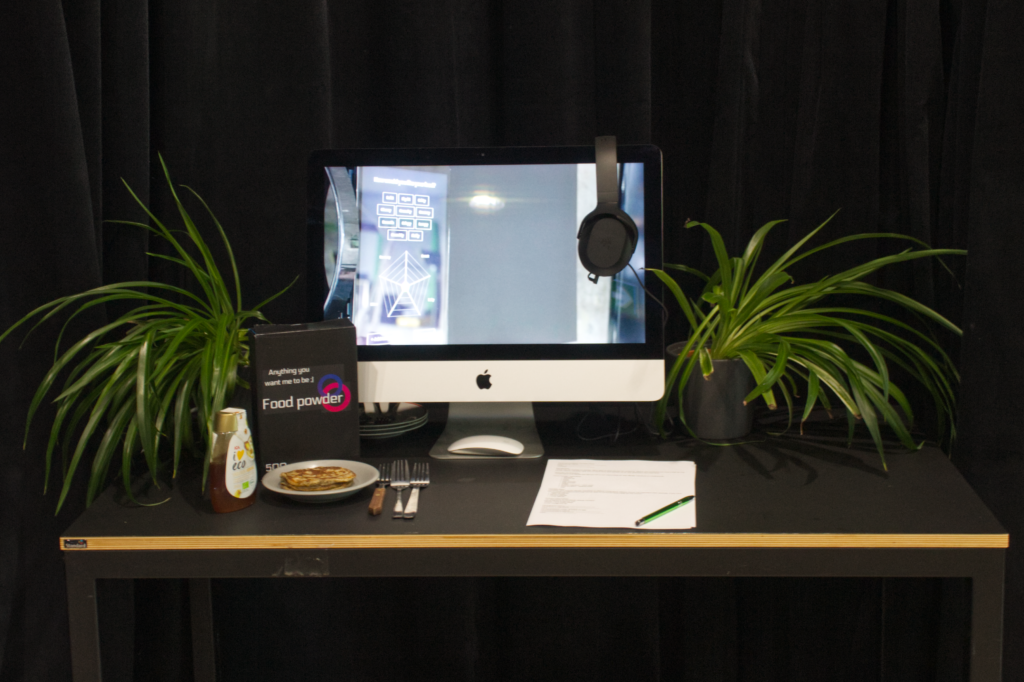
At the final presentation of the project, we brought with us an artefact from the future: pancakes that a citizen of the future had printed for themselves in the video. We let the audience try them and gave them a list of ingredients. Just in case, the pancakes were accompanied by a liability agreement from the printer powder manufacturer.
Artefact from the future: Pancakes
Ingredients: Banana, Chitin, Animal fat, Flour, Milk powder, Egg powder, Sugar, Salt, Citric acid, Baking soda
Possible risks: Latex allergy, Banana allergy, Chitin allergy, Seafood allergy
Only after the audience had tried our artefact did we reveal that chitin, listed among the ingredients, is another name for insects. More specifically, we used crickets to make these pancakes and had verified that they were truly edible and not harmful to humans. Judging by the audience's reaction, we can say that the artefact generated the desired buzz. Some people were concerned about the ingredients, while others were not bothered by them. The main and most important thing is that it sparked a discussion about food choices and food ingredients.