UI/UX design 2025

Making Estonian sign language learning more accessible through a digital learning platform

The current opportunities for learning Estonian sign language are limited and therefore not accessible to everyone. The number of people interested in learning the language is growing every year, but unfortunately, there are not enough teachers to teach them all. For my thesis, I developed a concept for a digital learning platform for Estonian sign language, which would ease the burden on teachers and make learning sign language more accessible to those interested.

This is my bachelor's thesis.

Supervisor

Carol Tikerperi

Consultant

Jari Pärgma

Time

Nov 2024 – May 2025

According to the Estonian Sign Language Association, interest in learning Estonian sign language has grown among people in recent years. Unfortunately, there are not enough teachers in Estonia to teach everyone who is interested, and there are not enough resources to train new teachers within five years.

The options currently available are also limited. Three methods are mainly used for learning at the moment, which are:

  • Paid courses in Tallinn or Tartu: Unfortunately, these are too expensive for some interested parties and/or do not take place at a suitable time or location.
  • Estonian sign language textbooks and dictionaries: There is no confirmation that you understand the content correctly for either resource, and the dictionaries do not include a grammar section.
  • Learning through a friend: Unfortunately, not everyone has a friend who can teach them Estonian sign language. Even if they did, there is no guarantee that their friend would teach them correctly.

In order to better understand the current situation regarding the learning of Estonian sign language I interviewed 18 people:

  • 4 knowledged persons – people who have previously studied sign language.
  • 3 experts – people who are active in the field of Estonian sign language development and teaching.
  • 11 interested persons – people who do not yet know Estonian sign language but would like to learn it.
The most significant insights from the interviews were the learners' motivation, obstacles, and needs.

Motivation:

  • Personal interest
  • A need to know for yourself or a loved one

Obstacles:

  • Lack of a consistent source
  • Fear of making a mistake
  • Lack of resources
  • Minimal practice opportunities

Needs:

  • Information must be clearly presented
  • Opportunity to practice with other students (this was left out of the thesis due to the project's scope)
  • The platform must guide and support

The final product is a digital learning platform that works in a web browser in a desktop environment. The platform allows users to learn both grammar and signs. When creating the content, I relied on Regina Paabo's Estonian sign language handbook 'Viibelda on mõnus'.

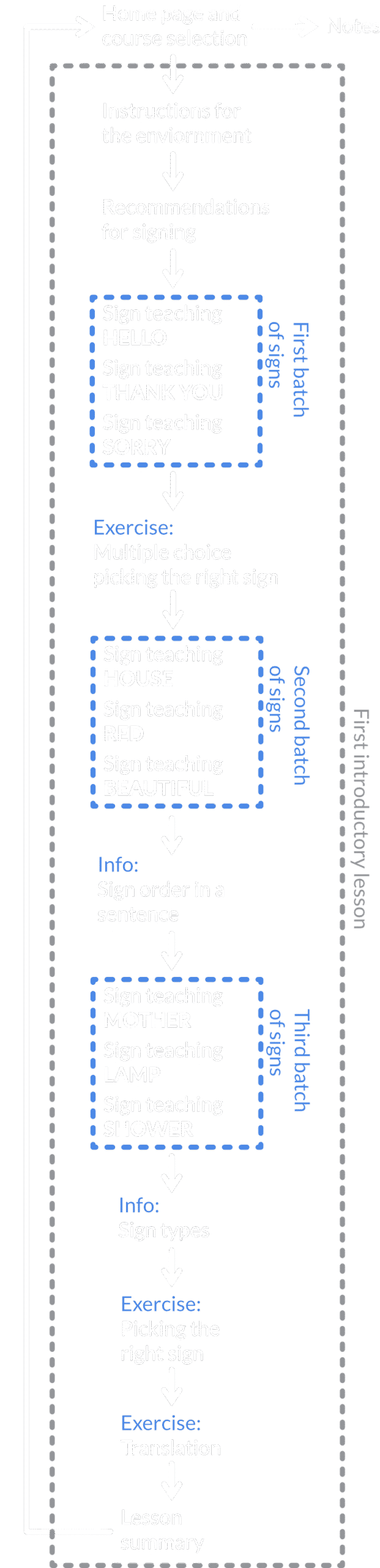
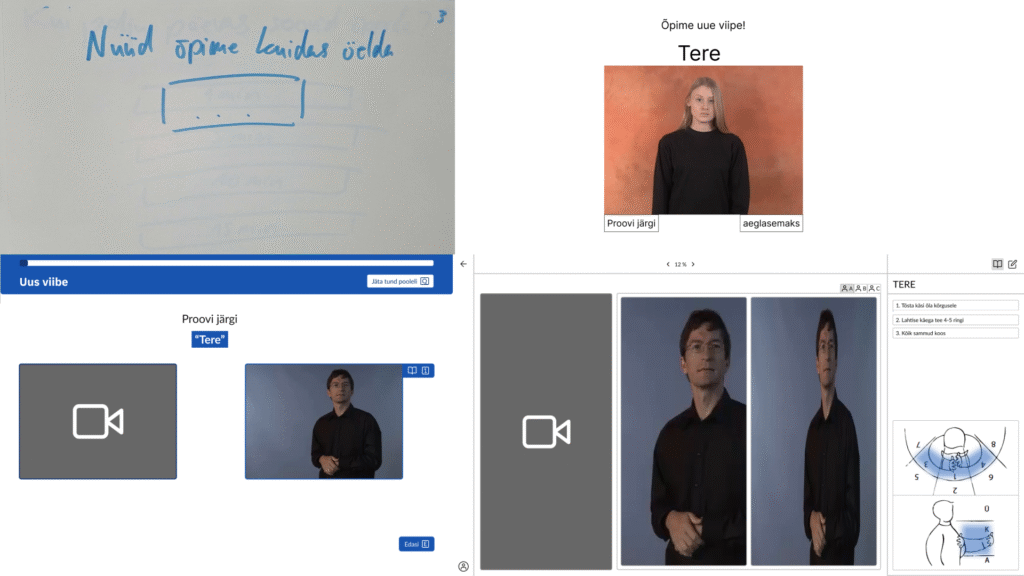
The prototype developed during the bachelor's thesis consists of two parts: the home page and the first lesson. The first lesson is divided into sign batches and exercises.
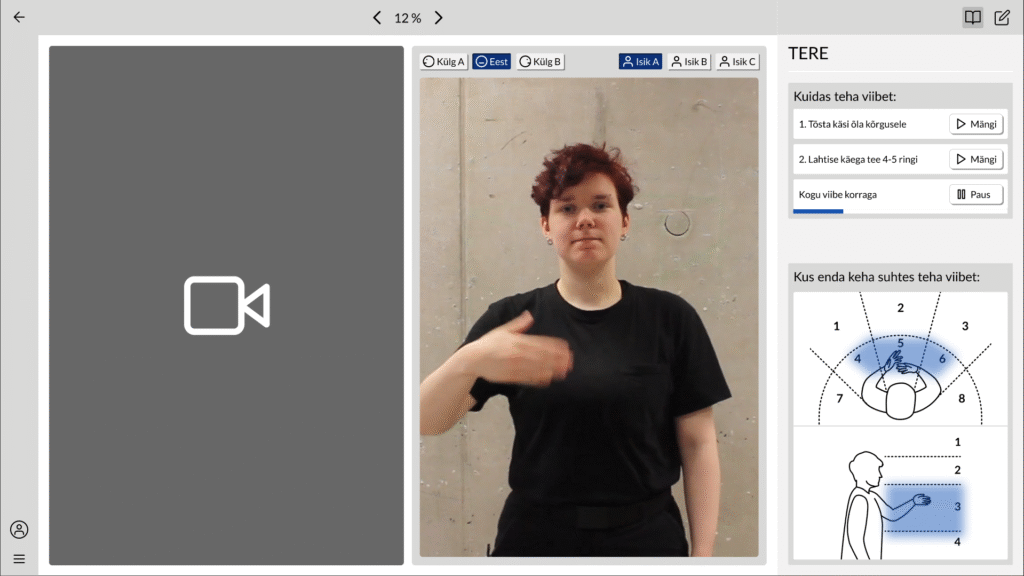
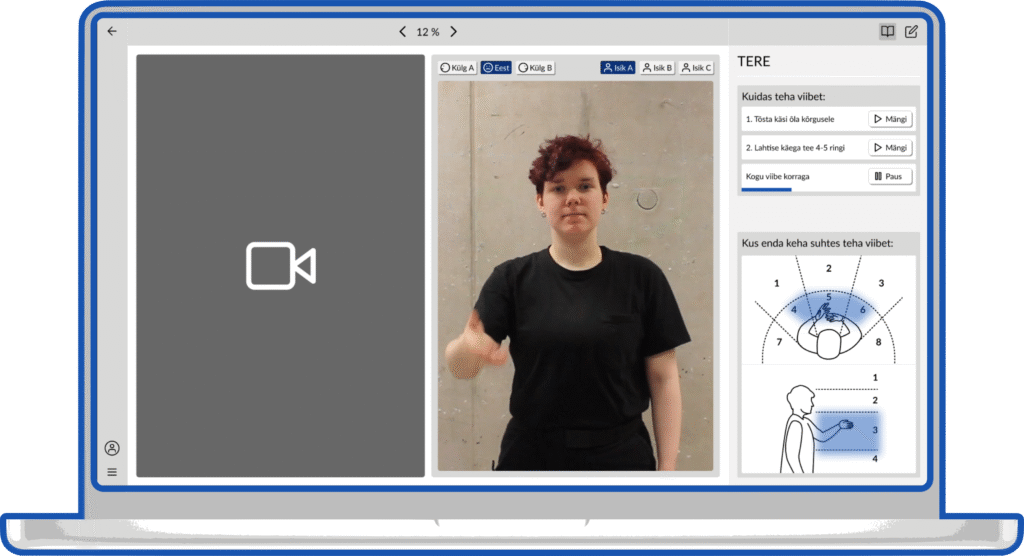
The learning platform allows you to view signs from multiple angles, switch between signers, read signs step by step in written form, locate signs in sign space, imitate signs yourself using a webcam, and learn Estonian sign language grammar.

When designing the user interface, it was important that the aesthetic aspect did not compete with the content of the learning material for attention. That is why gray tones are mainly used in the platform.

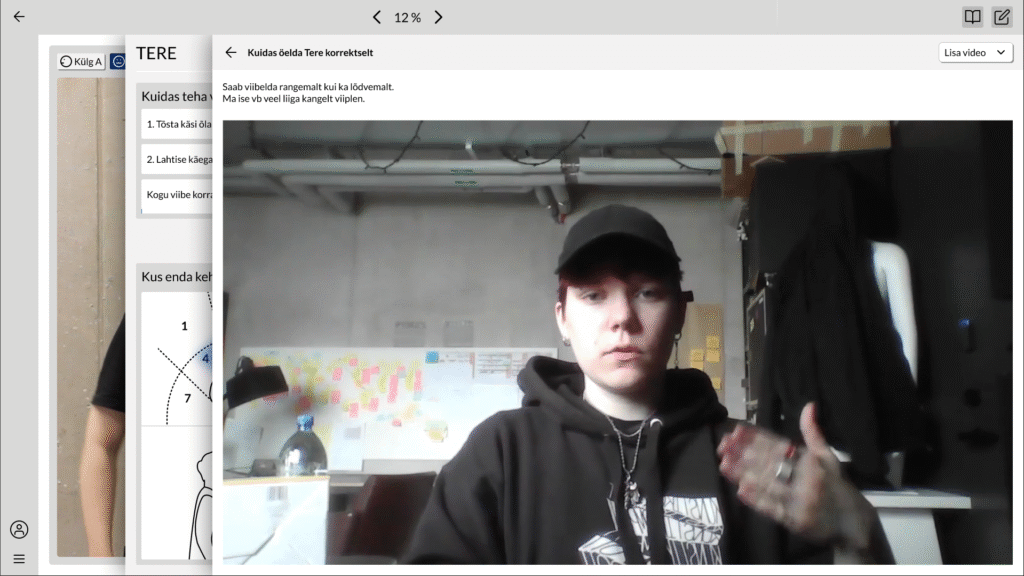
Since one of the pain points of the current situation was the lack of a single source, i.e., constantly switching between different environments to obtain the relevant information, a drawer system is used in the solution. This allows users to view the information they need without having to go to a new page.

The drawer system also includes a note-taking function. During the lesson, users can take notes with videos to better remember information that is important to them.

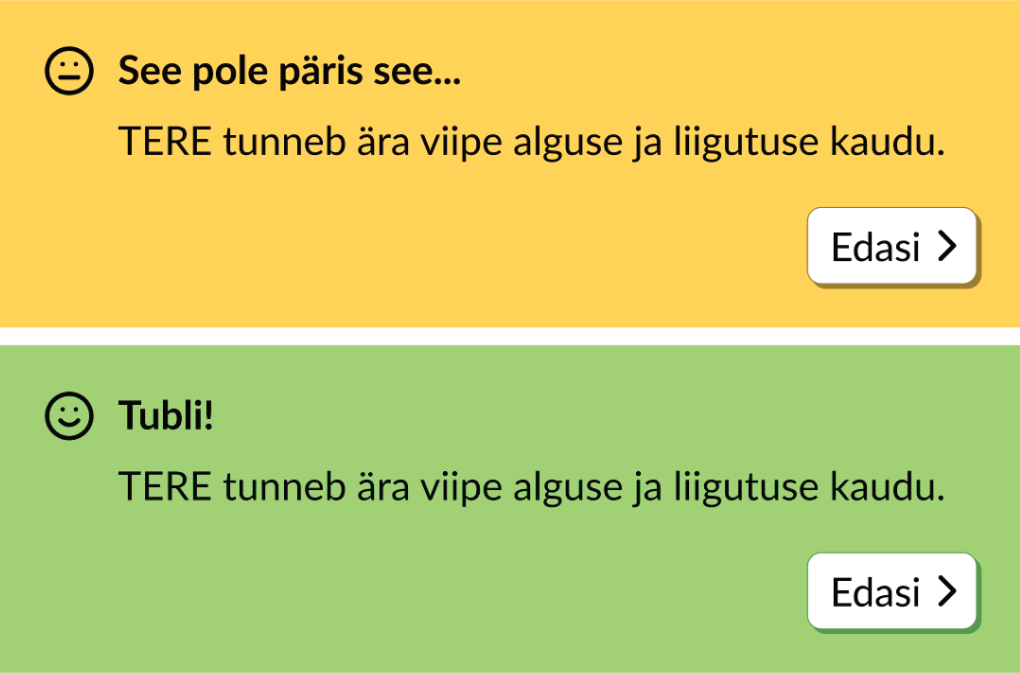
It was also important that the learning platform be supportive rather than punitive. Therefore, if a learner makes a so-called mistake in an exercise, instead of a red warning sign, a yellow notification appears with the words, "That's not quite right..." and additional information on how to do better in the future.

Structure of the prototype

When creating the solution, I tested the prototype through an iterative process, i.e., I developed the prototype continuously during testing phase. The final prototype was preceded by four prototypes, and I performed 12 tests.

Key insights from the tests:

  • Since sign language is a spatial language, it is important in digital learning that it is also shown spatially, i.e., from multiple angles.
  • A video may not always be enough. Additional materials, such as schematics and step-by-step explanations, help new learners better understand the concepts.
  • Seeing how different people sign gives the user more courage to join in themselves.
The digital learning platform takes some of the burden off teachers and gives those interested the opportunity to learn Estonian sign language more quickly. As it is a digital environment, learners can be more flexible in deciding how long, how much, when, and what they want to learn.

At the moment, the product remains at the conceptual level, but I am looking for opportunities to develop it further and turn it into reality.

You can read more about my thesis (in estonian) here.

Previous project:

Next project: